
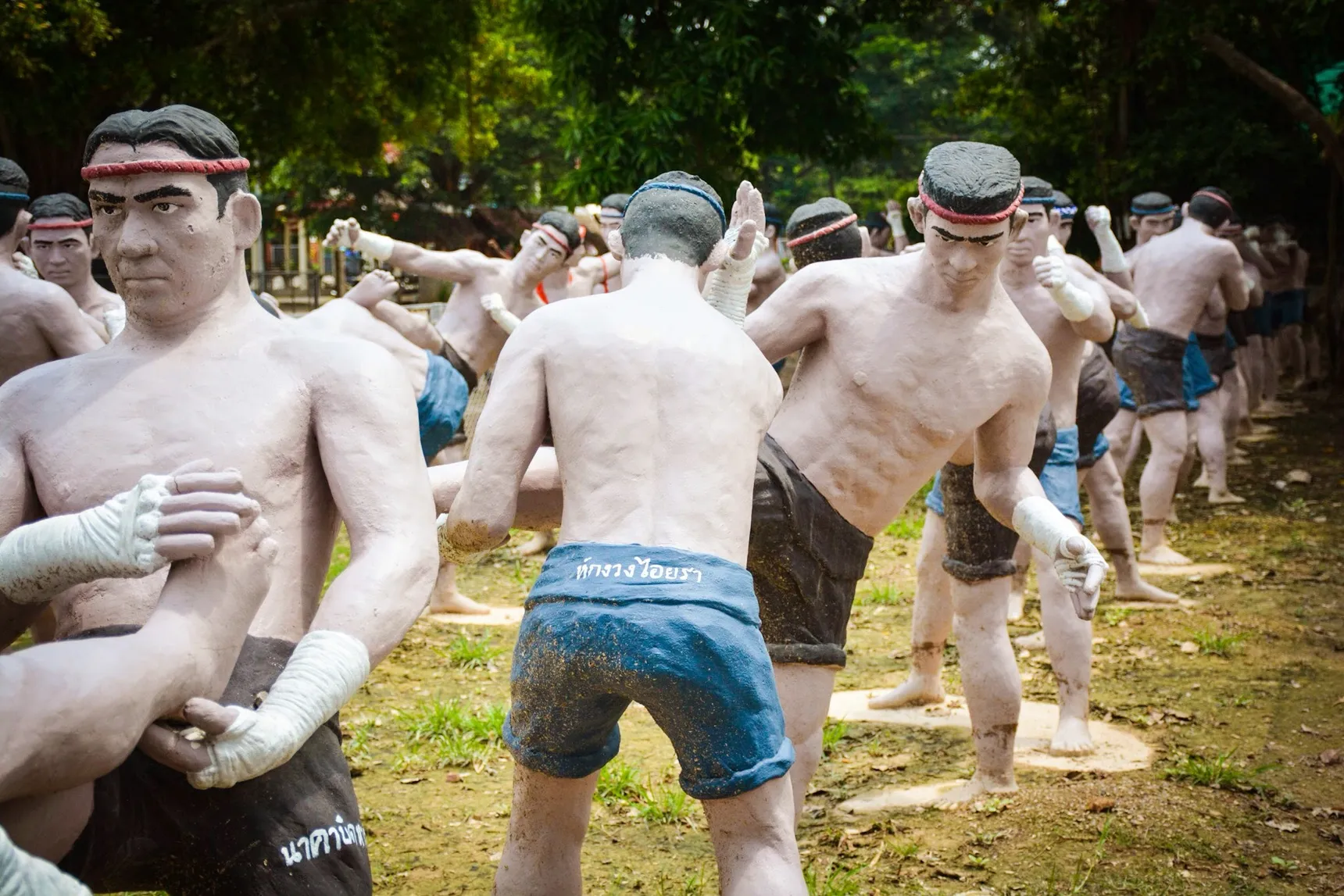
I wasn’t looking for it. I was walking the grounds at Bang Kung Camp, an old Ayutthaya-era fort site wrapped around a temple in Samut Songkhram, a couple of hours southwest of Bangkok — and there they were. Concrete fighters standing in the grass, each on a low plinth, each caught in the middle of a technique, a hundred of them running back under the trees.
Rope-wrapped hands. Head bands. Elbows up, shins turned over, teeps extended into nothing. It took me a minute to work out what I was actually looking at, which is that it isn’t a monument. It’s a curriculum.
What stopped me wasn’t the craft, though the craft is real. It was the structure.
Every figure is frozen at one instant — and it is never the wind-up and never the follow-through. It’s the moment where the shape of the technique is legible: the elbow at its arc, the knee at the top, the grip closed. Whoever sculpted these picked the single frame at which you can tell what the technique is.
And then, painted by hand across the waistband of every pair of shorts, is its name.
That’s not decoration. That’s a catalogue entry. One technique, held at its clearest pose, labelled with what to call it — and a long row of them you can walk at your own pace, doubling back to the ones you didn’t get. Somebody built a technique library out of concrete and stood it in a field, and it works better than most of the ones on the internet.
Shot Caller was standing at the far end of what that field had worked out, and I’d been circling it for months.
The app calls “1 2 3, Right Low Kick” out loud while you work, and for anyone who already speaks that language it does exactly what it should: hands free, eyes off the screen, nothing to decide mid-round. The callouts are the product and they work.
What they also do is assume the language. Come to it without knowing what 3 is and the calls arrive faster than you can decode them — not because anything is broken, but because the app is talking and you haven’t been taught the words yet. Everything good about it is on the far side of a vocabulary nobody had handed over.
We’d been handing it over in prose. Descriptions, key points, common mistakes. Turn the hip over and land with the shin, not the instep. Every word of that is true and worth reading — and nearly all of it lands better after you have seen the movement than before. Writing is a fine place to keep the detail. It’s a hard place to meet a shape for the first time.
Bang Kung had settled that question in concrete a long time before I turned up: stop describing it and show me the shape.
The obvious answer is video, and video is worse. This is the part it took the park to teach me.
A statue can’t move, and that turns out to be the best thing about it. A clip of a round kick is forty-odd frames of which thirty-nine are transit — the leg on its way somewhere. You watch it, you get a general impression of speed, and you learn almost nothing about where anything actually goes, because nothing holds still long enough to be studied. To learn from a clip you have to pause it, and to pause it usefully you have to already know which frame matters.
The statue does that part for you. It is a video that has already been paused on the right frame, permanently, by somebody who knew which frame that was.
So that’s what the figures in the app are built around. Each one runs six frames across about 1.15 seconds — enough to carry the rhythm, because a technique is also a piece of timing — but every sheet is cut around a single extension frame, the fourth of the six. Hit pause anywhere and it lands there. Step through with the arrow keys and that’s the one you stop on.
It’s the statue’s pose, with the approach and the recovery added back around it. Here are four — a fist, a shin, a knee and an elbow, which between them are most of the art:




Six frames, 1.15 seconds, built around the fourth — the extension
The other half of what the park got right is the label, and it’s the half I nearly missed.
A figure with no name is a picture. A figure with its name is a lookup — it closes the gap between the thing you can see and the thing somebody is about to say to you. Those statues carry the technique’s name in Thai script right where you cannot avoid reading it, and that is the whole difference between an art installation and a teaching tool.
Read the shorts and you find out what the row actually is. One pair is หักงวงไอยรา — hak nguang aiyara, “breaking the elephant’s trunk”. Another is นาคาบิดหาง, naka bit hang, “the naga twists its tail”. The first is the tenth of the fifteen Mae Mai, the foundational techniques every fighter learns first. The second is the twelfth of the fifteen Luk Mai — the ones you are meant to reach only once the Mae Mai are already in you.
So it isn’t a row of statues. It’s a syllabus, thirty entries long, standing in a field in the order it is meant to be learned. Which is the oldest idea in the art and the one we’d arrived at from the other direction: these first, then those.
In the app, the label does one extra job. Under every figure is the name, and under the name is the number the app is going to shout at you. Jab 1. Cross 2. Left Hook 3.
The shelf isn’t a gallery. It’s a decoder for the voice in your headphones.
Two things had to change on the way back, and neither of them is an improvement on that field. They’re the parts of it you can’t put in your pocket.
The order at Bang Kung is cast into the ground, and that is a strength where what’s being kept is a canon — the same thirty, in the same sequence, for everyone who has walked that row for as long as it has stood there. Nothing on a phone is that durable. What a phone can do instead is the one thing a fixed row was never asked to: keep track of which of the thirty you have got. So every lesson carries its place in the path with it — “Taught at level 4 of Start Here” is a link, and the path counts the vocabulary you have actually covered.
And a field stays where it is. You walk it, you leave, and what you keep is whatever you managed to remember. “Drill it” loads a style that calls the technique and starts the timer, so looking something up and hitting it are two halves of one errand. That’s the whole reason the library lives inside the app rather than on this website — not because it beats standing in front of the real thing, but because it’s there on a Tuesday night, and the real thing is on the other side of the world.
There’s more on how the path and the shelf fit together in the write-up of the Learn module.
Worth saying, because it cost months: every figure in the library is cut from real footage, frame by frame, by hand. None of them came out of an image generator.
The failure mode of a generated technique isn’t that it looks wrong. It’s that it looks plausible and is wrong — a flat rear foot on a cross, a “check” that’s really a knee, a guard hand drifting to exactly where the counter comes through. Errors that are invisible to precisely the person least equipped to catch them, who is the beginner the whole module exists for.
The fighters at Bang Kung were shaped by somebody who knew what they were shaping, and named by somebody who knew what to call it. It seemed like the wrong lesson to take from them and then ignore.
If a callout has ever gone past you because you didn’t know the word, that isn’t a gap in your fitness — it’s a gap in the vocabulary, and it closes fast once you can see the thing. Open Learn, scroll the shelf, and read the number under the name. It’s what I managed to carry home from a field full of concrete fighters, and the people who built that field had it right first.
Shot Caller Nak Muay calls real Muay Thai combinations out loud while you work. Free to start — the round timer, Freestyle and Nak Muay Newb cost nothing.
Prefer to try it in the browser first? Open the web version.